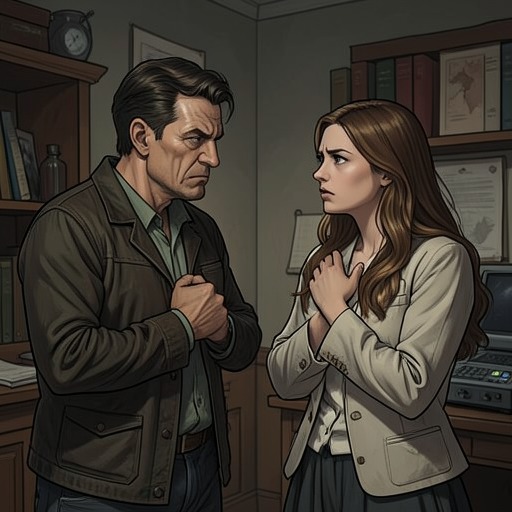
Adrienne–Bane relationship
Insatiable Box Set: Books 1-4The Adrienne–Bane relationship is a coercive struggle over captivity, pregnancy, and who has the right to claim Adrienne as a mate. Bane’s intentions shift from destroying her to wanting her for himself, but his fixation does not undo the threats and force through which he tries to possess her. Adrienne’s responses keep that contradiction in view: she challenges him, protects her children, and refuses to treat his desire as a substitute for consent.
Background: Adrienne’s existing bonds
Before Bane’s pursuit becomes central, Adrienne is already negotiating the demands of life with the Samsa brothers. In the cave, she calls herself a captive audience after Wilder tells her she is pregnant, and objects that he withheld the truth until after they had slept together. Wilder denies that she is captive and says she can leave, but also insists she cannot take the pup because of the danger to his heir. The exchange establishes a conflict between his assurance of freedom and the restrictions he places on Adrienne’s choices.
Adrienne’s attachment to Wilder is joined to both desire and apprehension. She feels lust, need, and love for him, yet fears a future as a sexual slave to three werewolves and worries about what they will do when they discover she believes herself infertile. Later, she remembers the cave as a place of happiness with Wilder and Lycell, and imagines claiming all three brothers and having their pups. That existing attachment matters to her dealings with Bane: she does not approach his claim as an unclaimed mate, but as someone whose loyalties and family life are already bound to the Samsas.
The brothers’ arrangement is not free of conflict. When Adrienne learns that Wilder intends to give her children to Mena and Robert because Mena is sterile, she objects that a mother should not be made to do that unless she has to. She also tells Wilder to stop controlling everyone’s lives and to ask Drayton and Lycell what they want. This context sharpens the later confrontation with Bane: Adrienne is defending her children and her own choices in a world where powerful men repeatedly try to decide the terms of her relationships.
Captivity and threats
Bane’s conduct makes the imbalance between them explicit. While taking Adrienne and Mena toward the truck, he says Mena and her pups will not be killed if she behaves, but calls Adrienne fair game. He describes the treatment of fertile females in his group as a practice of passing them among werewolves in the hope of producing pups. The threat places Adrienne’s vulnerability within a wider system of reproductive exploitation, rather than presenting Bane’s possession of her as an isolated romantic rivalry.
He later grips Adrienne’s wrists and threatens the pups she is carrying, placing his hand over her stomach and telling her that obedience may be the condition for keeping them. Adrienne warns him that harming her means harming her children. His threats thus target not only her bodily safety but also the bond she has with the unborn pups: he treats their survival as something he can grant or take away, while she insists they are part of her.
Bane’s claim is also tied to the power he believes Adrienne can give him. He wants to remove Wilder and his brothers so he can control Adrienne and their lands, and imagines becoming the Alpha of Alphas with her. The narration describes his threats as empty because his future now depends on her, and because he wants her devotion rather than merely her submission. That distinction describes his fantasy, not a change in Adrienne’s circumstances: he still holds power over her and continues to threaten her.
Fixation, law, and desire
Bane’s fixation develops against a rule he follows despite his hostility toward humans. He had intended to kill Adrienne, but when she reveals her pregnancy, the Hunter’s Law takes hold: “Never kill the female and never kill her if she’s pregnant.” He had previously opposed bringing human females into werewolf families, viewing them as inferior to werewolf unions. The pregnancy prevents him from carrying out his plan and becomes one point where law, survival, and his changing desire converge.
His interest grows beyond preserving her life. Bane begins to imagine Adrienne as his mate and the mother of his pups, a possibility made more consequential by the sterility of the werefemales in his group and the fact that his pack has had no pups born into it. He also believes that having her would help him acquire the authority he seeks. The relationship therefore joins personal obsession to a broader ambition: Adrienne is both the woman he wants and the means through which he imagines remaking his position among werewolves.
Bane sometimes presents himself as willing to wait. He asks what Adrienne would do if he said he needed to mate with her that night; when she counters that she does not want him, he says he will do nothing until she tells him to. He wants her to need him and forget Wilder. Yet the scene turns on the distance between this promise and their actual relationship: Bane has kidnapped her and threatened her children. When he kisses her, Adrienne does not return his affection. She recognizes a bodily response but remains loyal to the Samsa brothers, whose bond with her is too strong for her to abandon lightly.
Care, resistance, and unresolved pursuit
The tension between Bane’s professed care and his coercion also appears during their journey. Adrienne is weak, hungry, and pregnant, and objects that raw meat is not enough: she needs fruit and vegetables. Bane says he does not care about the Samsas’ pups but cares about her. Adrienne rejects the separation he tries to make between her and the children, telling him that if he does not want them, he does not want her. His attention to her predicament marks a change in how he sees her, but it does not establish trust or repair the harm of the abduction.
Their later exchange about intimacy makes the lack of consent still clearer. Bane kisses Adrienne softly, then forces his tongue into her mouth. She clutches the bed rather than reciprocating, and the narration distinguishes her possible physical response from her continuing love for the Samsa brothers. Bane, disappointed by her refusal, compares her unfavorably with werefemales, whom he says know their duty, and asks whether he must treat her like one of them to make her respond. Adrienne answers by naming the facts he evades: he kidnapped her and threatened her children. Desire, in this scene, is not mutual agreement; his longing collides with her refusal and with the danger he has created.
The relationship remains unresolved as Bane continues to track Adrienne. From a snow-covered mountain, he hears her voice and recognizes her calling Wilder’s name. The sound tells him that Wilder is with her and possesses the intimacy Bane wants for himself. He follows the direction of her cries, pulled by jealousy and desire. The episode leaves their conflict active: Bane’s fixation has not displaced Adrienne’s attachment to Wilder, and his pursuit continues without any evidence that she has accepted him as a mate.